Mirza Ghulam Ahmad (MGA) of Qadian had a habit of making prophecies about the future. He was so confident about the veracity of those predictions that on more than one occasion, he presented his prophecies as a means of establishing his truthfulness. Even stating that if a single prophecy of his proved false, it would demonstrate that he was a liar (کذاب).
Among those prophecies he made, several concerned his expected lifespan. He once claimed that he would live close to 80 years of age, and according to some statements, up to six years more or less, i.e. he will live between 74 – 86 years of age.
According to the dates and statements attributed to Mirza himself, his birth occurred sometime between 1839 and 1842. He died in May 1908 after contracting cholera.
If we take MGA’s word and assume his birth year to be 1839, his age at death would have been approximately 69 years.
In other words, someone who predicted that he would live to approximately 80 years of age did not even reach 70.
As one can guess, this age issue became a source of humiliation and embarrassment for the Ahmadiyya community, who began facing criticism and condemnation from all sides, Muslims, Hindus and Christians alike. So, something had to be done, obviously. And the responsibility fell on the shoulders of none other than MGA’s younger son and author of Seerat-al-Mahdi, Bashir Ahmad MA,
To get MGA’s age as close to 80 as possible, Bashir came with a clever solution. Since his death year of 1908 was an established fact and could not be altered, only other option left for Bashir was to move MGA’s year of birth as far back as possible. And to support this, two “facts” were brought in to play.
- A statement from MGA claiming his birthday fell on a Friday and coinciding with the 14th day of the lunar month.
- An oral account attributed to one of his disciples, Mufti Muhammad Sadiq, according to which Mirza was born during the traditional Indian month of Phagun (پھاگن).
These details were subsequently brought together in an article that claimed MGA’s date of birth has finally been established. This article was published in the Qadiani newspaper Al-Fazl, 28 years after Mirza’s death in August 1936.
In this article, Bashir Ahmad, presented a table of possible dates between 1830 and 1840 on which a Friday on or close to the 14th day of the lunar month during the Hindi/Bikrami month of Phagun.
At first glance, this might appear to provide a straightforward way of identifying MGA’s birth date.
However, there is an important detail with the Bikrami calendar calculations that needs to be considered before we can examine the evidence presented by Bashir MA.
The Bikrami calendar uses two different systems for specifying the current month:
1. Solar
The solar calendar calculates months according to the movement of the sun. Depending on the calculation, a month may contain 30, 31 or 32 days.
2. Lunar
The lunar calendar determines months according to the phases of the moon. A lunar month lasts approximately 29.5 days.
These systems follow different astronomical cycles and their months do not always coincide. Thus, for example, while the solar month may be Phagun, the corresponding lunar month may be Magh or Chet.
This distinction is particularly important when converting dates to/from the Bikrami calendar and Gregorian calendar. And for any date conversion to be consistent, the same calendar system must be used throughout.
It would not be methodologically sound to calculate some dates according to the solar calendar and others according to the lunar calendar, especially when comparing them against the same set of conditions.
With this in mind, let us examine the dates presented by Bashir MA.
For this examination, we used a Hindi/Nanakshahi calendar converter, which is freely available online and is considered a reliable reference by Sikh religious bodies. https://nanakshahi.net/convert
The original article by Bashir MA can be viewed below.
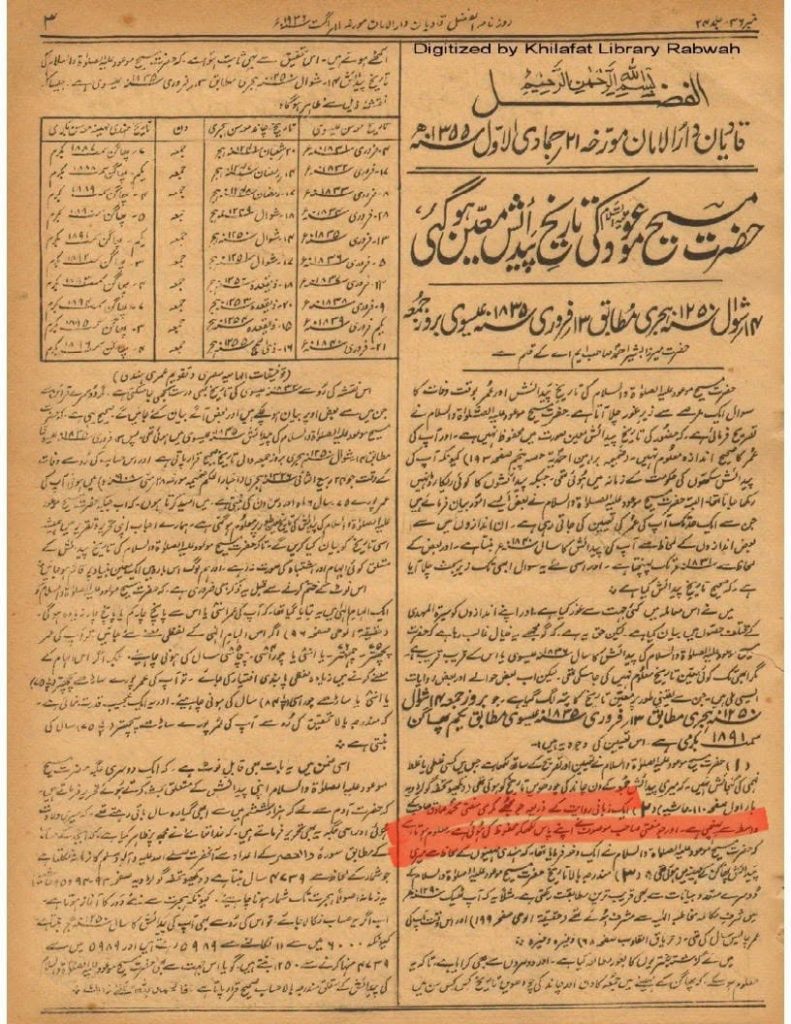
Upon examining the dates presented in Bashir MA’s article using the calculator mentioned above, an interesting inconsistency emerges. All the dates in the table, with one exception, were calculated according to the lunar calendar.
The exception was:
13 February 1835.
This was the only date calculated according to the solar calendar.
Significantly, this was also the date that satisfied the required conditions:
- It fell during the Hindi month of Phagun.
- It was a Friday.
- It coincided with the 14th day of the lunar month.
And this was the date that Bashir MA claimed as Mirza Ghulam Ahmad’s date of birth. This raises a very important question.
Why this particular date was calculated according to the solar calendar when the other dates in the same table were calculated according to the lunar calendar?
If 13 February 1835 had been converted according to the lunar system, just like all the other dates, it would have fallen in the Hindi month of Magh rather than Phagun thus failing the condition of the Hindi month of Phagun.
This is not a minor technical distinction. It directly affects whether the date satisfies the conditions being used to establish Mirza’s birth date.
The inconsistency therefore raises a legitimate question about the methodology used in the original article by Bashir MA.
Was the calendar system applied consistently throughout the experiment, or was an outcome driven manipulation performed to arrive at the desired result?
Considering the impact the outcome of this theory had on the Kadiani community’s theological beliefs, the latter seems more plausible.
However, there is another important question that deserves equal attention.
What if the solar calculation method is applied for all years?
The answer to this question is, when the solar calendar is applied, 13 February 1835 is not the only date that satisfies the stated conditions.
Another date also meets the same criteria:
1 March 1839.
This date also falls in the Hindi month of Phagun, occurs on a Friday, and coincides with the 14th day of the lunar month.
To further make this date particularly relevant to the discussion, remember the claim Mirza himself made indicating that his birth occurred in either 1839 or 1840.
This fact cements 1 March 1839 as the correct date of MGA’s birth, consequently, confirming that MGA indeed failed to reach even the age of 70, despite his prophecies of living close to 80.
The central issue here is not simply whether one particular birth date can be identified.
The selective application of two different calendar systems raises questions that demands a clear explanation.
Was the author so incompetent that he did not understand the different calendar systems in use or was he resorting to deceitful tactics of end justifies the means to achieve a desired outcome?
According to Bashir MA, this methodology was cross checked by other members of his organization as well. Does this mean that other members of this self-proclaimed religious community were also as involved in the conspiracy? Why was not the underlying methodology made transparent, consistent and open to examination?
The purpose of examining these dates is not to question anyone’s personal faith or religious convictions. Rather, it is to encourage a closer examination of a historical claim and the explanations subsequently offered to support it.
The relevant points are straightforward:
- Mirza Ghulam Ahmad made statements predicting a lifespan of approximately 80 years.
- He died in May 1908.
- Even using 1839 as his year of birth, his lifespan would have been approximately 69 years.
- His son, Bashir Ahmad MA, subsequently presented a table of possible birth dates using the Bikrami calendar.
- According to the calculations discussed above, the table appears to use the lunar calendar for almost every date, with 13 February 1835 being the exception.
- Applying the solar calendar consistently also identifies 1 March 1839 as a date satisfying the stated conditions.
- This alternative date still results in a lifespan of approximately 69 years.
These points raise an important question about both the original prediction and the subsequent attempt to reconcile it with MGA’s actual lifespan.
For followers of Mirza Ghulam Ahmad, this is an opportunity to examine the matter independently rather than relying solely on explanations provided by religious authorities or community publications.
If Mirza Ghulam Ahmad himself established that the failure of even one prophecy would demonstrate his lack of truthfulness, how should his prediction of living to approximately 80 years be understood in light of these dates?
It is a question worth investigating honestly and without prejudice.
Ultimately, historical claims should stand on the strength of their evidence, and calendar calculations should stand on the consistency of their methodology.
| Gregorian Date | Hindi Date | Islamic Date | Calculation Method |
|---|---|---|---|
| 04 February 1831 | 7 Phagun 1887 | 20 Sha’ban 1246 | Lunar |
| 17 February 1832 | 1 Phagun 1888 | 14 Ramadan 1247 | Lunar |
| 08 February 1833 | 4 Phagun 1889 | 17 Ramadan 1248 | Lunar |
| 28 February 1834 | 5 Phagun 1890 | 18 Shawwal 1249 | Lunar |
| 13 February 1835 | 1 Phagun 1891 | 14 Shawwal 1250 | Solar |
| 05 February 1836 | 3 Phagun 1892 | 17 Shawwal 1251 | Lunar |
| 24 February 1837 | 4 Phagun 1893 | 18 Dhu al-Qi’dah 1252 | Lunar |
| *09 February 1838 | 7 Phagun 1894 | 20 Dhu al-Qi’dah 1253 | Lunar |
| 01 February 1839 | 3 Phagun 1895 | 15 Dhu al-Qi’dah 1254 | Lunar |
| 21 February 1840 | 4 Phagun 1896 | 16 Dhu al-Hijjah 1255 | Lunar |

